Mastering a Business Process Optimization Strategy


At Four Indoor Courts Consulting, that pain is the first clue. It’s the signal that your current processes have hit capacity. You’re doing too much manually, repeating the same manual tasks week after week, and losing visibility on what’s really slowing you down. The business has grown up, but its business process management system hasn’t.
Why Business Process Optimisation matters for all SMEs
In 2025, a business process optimization strategy isn’t a corporate luxury - it’s a survival skill.
Sectors move faster, teams are leaner, and AI is rewriting the playbook for operational efficiency and optimized processes. The leaders who win are those who stop reacting and start refining their current processes through structured approaches and business process management. Those who take the best new technologies, alongside experienced advice, and use them to smartly redesign their most complex processes.
At Four Indoor Courts Consulting (FICC), we see the same pattern across every sector: founders spend so much time inside the game that they lose sight of the bigger court. Process optimization - or 'fractional leadership in motion' - helps them step back, find clarity, and build a business that runs efficiently, not endlessly.
This article blends fresh U.S. research, real-world case studies, and FICC’s founder-friendly voice with guidance from recent leaders in process excellence - Kissflow, IBM, PMI, BOC Group, and EO Johnson - to show you how to master continuous improvement in 2025.
Key Takeaways
- AI is mainstream. 57% of U.S. operations leaders integrate AI into workflows, yet only half believe they use it effectively (PwC 2025 Digital Trends).
- Process mining pays off. Deloitte’s 2025 survey shows enterprise-wide adoption delivers triple ROI versus pilots.
- Process mapping drives visibility. Kissflow highlights mapping as the first step in any optimization journey, before automation or redesign.
- Case studies show results. U.S. brands like Alorica and JB Consulting report multimillion-dollar savings, faster cycle times, and sharper customer satisfaction scores.
- Continuous improvement is the win. Feedback loops, metrics, and culture - not one-off projects - keep teams in rhythm.
What Is a Business Process Optimization Strategy?
A Business Process Optimization Strategy is the disciplined practice of examining how work flows through your business - and making it faster, smarter, and simpler.
As IBM notes, optimization sits at the heart of business process management, leveraging automation, analytics, and Six Sigma tools to reduce error rates and enhance quality management. It’s not about replacing people; it’s about redesigning processes so your people can perform at their best.
At FICC, optimization starts with empathy: understanding where founders feel buried in repetitive tasks, manual data entry, or decision-making bottlenecks - then designing new processes that release capacity and restore balance.
Expert Perspectives & Proven Frameworks
Independent authorities align on a consistent method:
- Kissflow recommends: review current processes, build process maps, identify root causes, redesign, test, and monitor for continuous improvement.
- IBM defines optimization as part of a continuous BPM cycle - combining automation, data analytics, and Six Sigma to lift process performance and the bottom line.
- PMI stresses that optimization succeeds when projects follow the DMAIC cadence (Define - Measure - Analyze - Improve - Control), keeping improvements tied to measurable key performance indicators.
- BOC Group reports that well-governed programs achieve 15-30 % cost reduction and measurable cost savings within 12 months.
- EO Johnson reminds leaders that improvement begins by mapping the as-is flow to uncover process inefficiencies that slow customer service.
Defining Key Processes and Objectives
Before you can optimize, you have to see the whole court.
- Identify your key processes - those that directly affect revenue, customer needs, and efficiency.
- Define what “better” means: faster cycle times, lower error rates, or happier clients.
- Measure the baseline with accurate data collection and process documentation.
- Start where pain and payoff are highest; optimizing one specific process well beats overhauling ten halfway.
Why Businesses Must Optimize for Lifecycle Efficiency
Optimization builds resilience and clarity across the full business lifecycle - from acquisition to service delivery to renewal.
- End-to-end visibility reveals hidden root causes and unnecessary steps.
- Resilience enables faster pivots when market conditions shift.
- Scalability protects teams from burnout as you streamline operations.
- Customer satisfaction rises as errors disappear.
- Profitability compounds through efficiency gains and better resource utilization.
Process efficiency is not an edge - it’s the entry fee!
Key Steps to Developing Optimized Processes
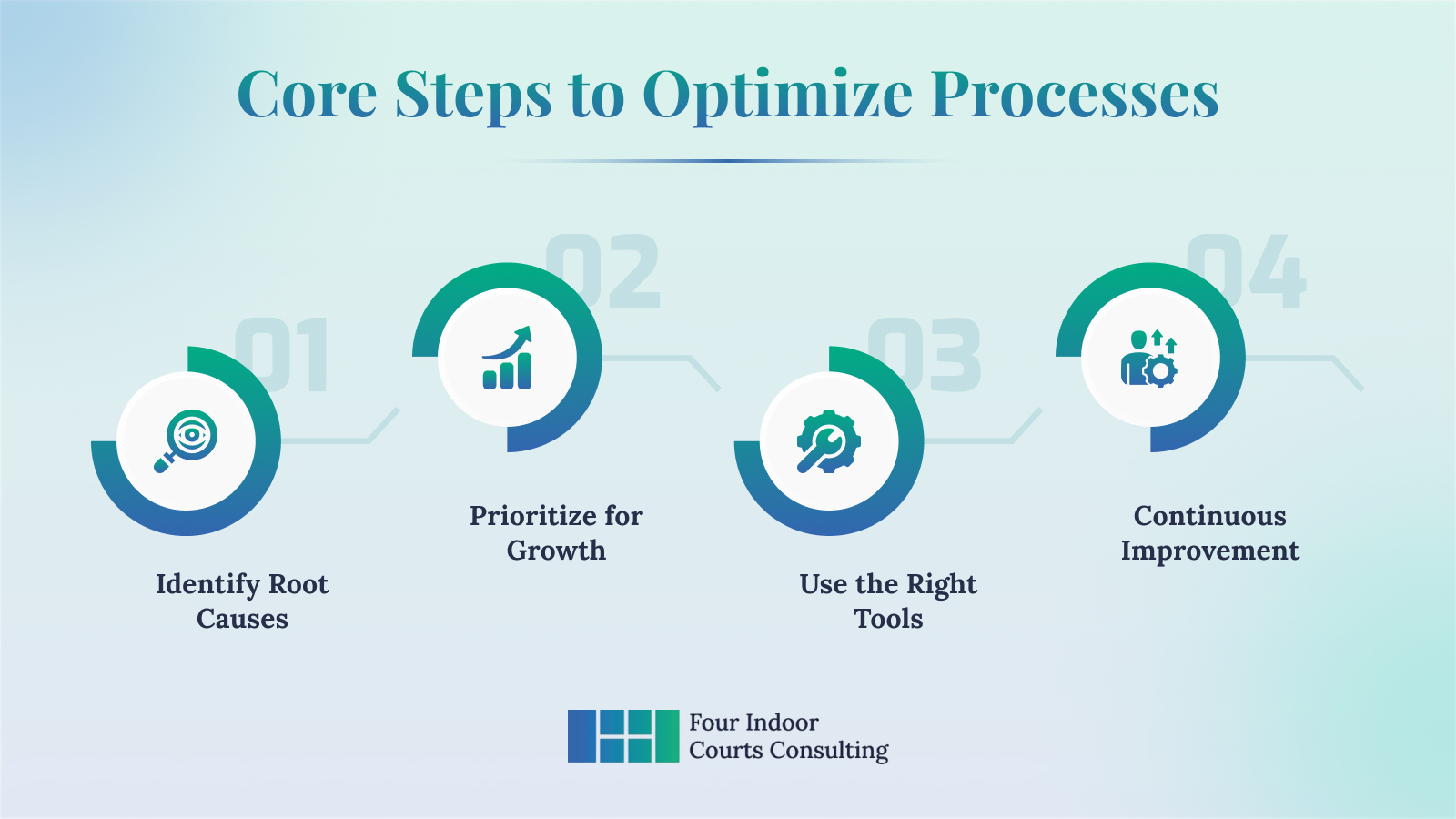
1. Identify Root Causes
Every inefficiency has a story. Use process mapping and process mining to visualize the workflow, expose process inefficiencies, and isolate root causes.
Combine data analytics, error-rate analysis, and root-cause analysis for precision.
1a. Apply DMAIC and Project Management Discipline
Adopt the Six Sigma DMAIC framework:
Define the problem → Measure with real-time KPIs → Analyze process data → Improve by removing manual tasks → Control with ownership and feedback loops. This blend of quality management and project management ties every change to measurable business objectives.
2. Prioritize Initiatives for Growth
Rank opportunities by impact × effort.
Ask: Which change reduces operational costs fastest? Which relieves founder stress? Which improves customer satisfaction?
Start small, prove value, build credibility.
3. Use the Right Tools
- Business Process Automation: Automate manual tasks and repetitive workflows.
- AI & Machine Learning: Predict delays and recommend next steps.
- Process Mining: See how work actually flows. Deloitte 2025 found full-scale adopters gain triple ROI.
- Analytics Dashboards: Real-time visibility keeps leaders proactive.
4. Build Feedback Loops for Continuous Improvement
An optimized process today may be outdated next quarter.
Embed continuous process review: monthly metrics checks, quarterly process mining snapshots, and named process owners who keep improvement continuous.
Optimization vs. Improvement
Optimization fine-tunes existing processes; improvement re-designs the system itself.
The lesson from Kissflow and BOC Group: start by optimizing what you have to learn where full redesign is worth the investment.
Industry-specific, Business Process Optimization Examples
Manufacturingcompanies: Cutting Costs Without Cutting Corners
A leading U.S. manufacturer lowered operational costs 15% and improved product quality using AI-driven logistics (PwC Digital Supply Chain 2025).
McKinsey 2025 found high-performing manufacturers - those using process mining and Six Sigma - enjoy 35% higher revenue growth and 10% higher margins.
Insurance & Financial Services: Enhancing the Experience
A U.S. insurer using AI-powered process mining reduced claim cycle times 30% and improved customer satisfaction ratings. A healthcare client of JB Consulting digitized field audits, eliminating manual data entry and cutting errors by 70%. Alorica’s routing automation achieved $2.5 million in cost savings and measurable service delivery improvements.
Back-Office Wins
EO Johnson’s research shows that digitizing document routing and automating task management in the back office lifts customer satisfaction and releases staff time for higher-value work.
Measuring Process Performance and Success

FICC tracks both operational and human metrics:
- Cycle times and error rates → efficiency
- SLA compliance and key performance indicators → reliability
- Customer satisfaction → experience
- Employee involvement → morale
Control Plan:
- Review hot processes weekly; stable ones monthly.
- Maintain versioned process maps and process documentation.
- Assign a named process owner to monitor alerts and coordinate incremental changes.
Adapting to Market Demands for Competitive Advantage
The U.S. economy is deep in AI transformation. According to Business Insider 2025, 70% of CEOs expect AI ROI within three years (up from 21% in 2024). This confidence is driving faster delivery, data-backed decision-making, and more agile management processes. A BOC Group analysis shows companies sustaining process optimization initiatives cut operational costs 15–30% within 18 months - proof that continuous improvement pays.
Emerging Priority: Culture & Change Management
At FICC, the hardest part isn’t the workflow - it’s the people.
Optimization fails without belief, ownership, and rhythm.
- Communicate why, not just what. Share how each change reduces friction and improves user experience.
- Involve the team early. Run “process clinics” where team members map pain points.
- Provide training and support. New tools need new behaviours.
- Embed ownership. Appoint process champions and reward quality improvement.
- Share wins. Publish quick success stories - customer satisfaction up 5%, error rates down 50%.
Technology Frontiers: What’s Next in Process Optimization
- Autonomous Workflow Agents & AI Orchestration
Next-gen automation solutions learn and self-optimize, improving decision points without extra human intervention. - Process Mining & Predictive Monitoring
Combine AI with process mining to understand not only where the bottleneck is, but why. - Sustainable & Composable Processes
Design modular, eco-aware systems that adapt fast to shifting market demands and sustainability standards.
Picking the First 90-Day Project
Start where pain is visible: high-volume flows that trigger customer complaints or late invoices.
Use process mining to confirm the true flow and identify areas with delay or rework.
Pick a small slice, deliver one quantified win, and publicize it internally — the best marketing for transformation is proof.
Bringing It All Together: FICC’s Roadmap
- Map three workflows in 30 days and isolate a first-step metric.
- Deliver a 90-day process improvement pilot.
- Launch a continuous-improvement rhythm.
- Pilot one emerging-tech capability.
- Build process literacy and employee involvement.
- Survey team ease and morale quarterly.
- Evolve processes modularly to preserve competitive advantage.
How It Works: From Overwhelm to Optimization

Every founder knows the feeling - the moment when the inbox is overflowing, meetings are stacked, and the business feels like it’s running you instead of the other way around. That’s where most FICC clients start: in pain. Not failing, just fraying. Growth is happening, but systems haven’t kept up. The team is firefighting. Data lives in spreadsheets. Every decision feels reactive.
At Four Indoor Courts Consulting, that pain is the first clue. It’s the signal that your current processes have hit capacity. You’re doing too much manually, repeating the same manual tasks week after week, and losing visibility on what’s really slowing you down. The business has grown up - but its business process management system hasn’t.
Pain: The Founder’s Blind Spot
The typical founder story follows the same pattern:
- Too many hats. You’re the strategist, operator, HR lead, and chief problem solver.
- No real-time view. By the time reports arrive, the problems have already multiplied.
- Rework and bottlenecks. You’re surrounded by repetitive tasks and process inefficiencies that bleed hours and profit.
- People friction. Talented team members feel stuck in a system that’s clunky or unclear.
- Decision fatigue. You can’t see what to fix first because everything looks urgent.
One FICC client, a regional real-estate founder, described it like this:
The truth is, most small-business pain isn’t caused by poor effort; it’s caused by invisible friction.
When existing processes aren’t documented or measured, you can’t spot where time and money leak away. That’s the hidden cost of growth without structure, high operational costs, low resource utilization, and founders trapped inside their own business.
Promise: A Clear Court to Play On
The breakthrough comes when founders stop trying to 'work faster' and start building efficient processes.
That’s the promise of process optimization: clarity, rhythm, and breathing space.
At FICC, the process begins with a clarity call - your first diagnostic. Together, we map three or four key processes: onboarding, delivery, and billing are the usual culprits.
Through process mapping and short team interviews, we uncover root causes - the unnecessary steps, slow approvals, or missing metrics that stall progress.
We translate that discovery into a visual process map that shows exactly where the business loses traction.
From there, FICC applies a structured approach - a mix of Six Sigma, workflow analysis, and plain common sense - to rebuild the flow.
Automation handles the repetitive. Dashboards create real-time visibility. Owners are assigned, metrics tracked, and meetings shortened.
This is where continuous improvement becomes cultural nad business growth becomes natural.
Once the first quick win lands - maybe a 25% cut in cycle times or 30% fewer error rates or quality issues, belief spreads.
Team members start bringing their own ideas. Meetings shift from ‘what went wrong’ to ‘how can we make this faster or better?’
Momentum builds because improvement becomes visible, in both data and energy.
Payoff: Balance, Growth, and Breathing Room
The payoff is tangible. Across dozens of projects, FICC’s clients report:
- Reduced operational drag. 15-30% fewer delays in everyday business operations.
- Higher customer satisfaction. Smoother service delivery means faster responses and fewer customer complaints.
- Cost reduction. Automation and process mining expose waste, unlocking thousands in annual cost savings.
- Team energy restored. With manual tasks eliminated, employees focus on meaningful work.
- Founder freedom. Clear data replaces guesswork; delegation becomes safe again.
For one multi-location recreation business, optimization meant introducing business process automation across scheduling, billing, and maintenance. Within 90 days, cycle times fell 28%, error rates dropped from 9% to under 3%, and the owner finally stepped away from day-to-day chaos.
The emotional shift is as profound as the operational one.
Founders move from survival mode to strategy mode.
They start seeing opportunities again, not just obstacles.
Their business objectives realign with their personal goals.
And because every key performance indicator is visible in real-time, they can finally trust their business to run, not just hustle.
Why It Works
Because business process improvement fixes process performance and mindset.
It transforms existing processes into living systems that evolve.
FICC’s approach anchors every change in the founder’s world - not corporate theory.
Every sprint ends with a check on two things:
- Are we closer to the business goal?
- Does the founder feel lighter, clearer, and more in control?
When both are true, optimization stops being a project and becomes a way of working.
Closing Thoughts
In tennis, the best players don’t always hit harder - they anticipate, adapt, and respond with precision. Likewise, in business, optimization isn’t about speed but intelligence. With a robust business process optimization strategy powered by process mapping, process mining, and continuous improvement, founders can reduce operational costs, increase customer satisfaction, and regain control of their time whilst realizing their business goals.