Crafting an Effective Operational Excellence Strategy (or, 'what can SMBs learn from big business success')


Operational excellence isn’t a corporate luxury, it’s a small-business superpower and a fast track to your business goals.
So, how can small businesses can use big-company principles, modern tools, and everyday data to run smoother, smarter, and stronger?
Read on to discover how founders and leaders of small to medium-sized businesses can adapt big-company practices like Lean, Six Sigma, and data-driven improvement to their own scale. We explore the core principles, modern tools, and digital innovations - including new technologies in AI, automation, and social media analytics - that make operational excellence achievable for any growing company.
Operational Excellence: It's not just for big business
For years, 'operational excellence' sounded like something that belonged in a global manufacturer’s boardroom. In 2025, that idea is outdated. Whether you employ five or fifty people, there is lots to learn from how the Fortune 100 achieve operational excellence, and neat ways to interpret it for your own business.
It's easier for smaller business too: teams can move faster, make decisions quickly, and change processes without layers of bureaucracy. Improvement opportunities might be easier to spot and faster to adopt. The goal isn’t to install corporate red tape in your business environment, it’s to borrow the discipline of big companies and apply it with small-business agility.
Operational excellence is about clarity, accountability, and consistency. It's the difference between daily chaos and calm, confident control.
Understanding Operational Excellence Strategy
At its core, operational excellence is a mindset. It means running every part of your business (people, process, and technology) in a way that consistently delivers value to customers while using resources efficiently.
For small-business leaders, it’s not about creating a complex system; it’s about aligning small and meaningful improvements with your vision and goals. It’s how you make sure the energy you spend actually moves the business forward. Founders need to think like big business CEOs, to take the principles that work and adapt them for their own scenario. When we take the systematic approach of a large enterprise, and apply it to a small business, the transformation can be seismic.
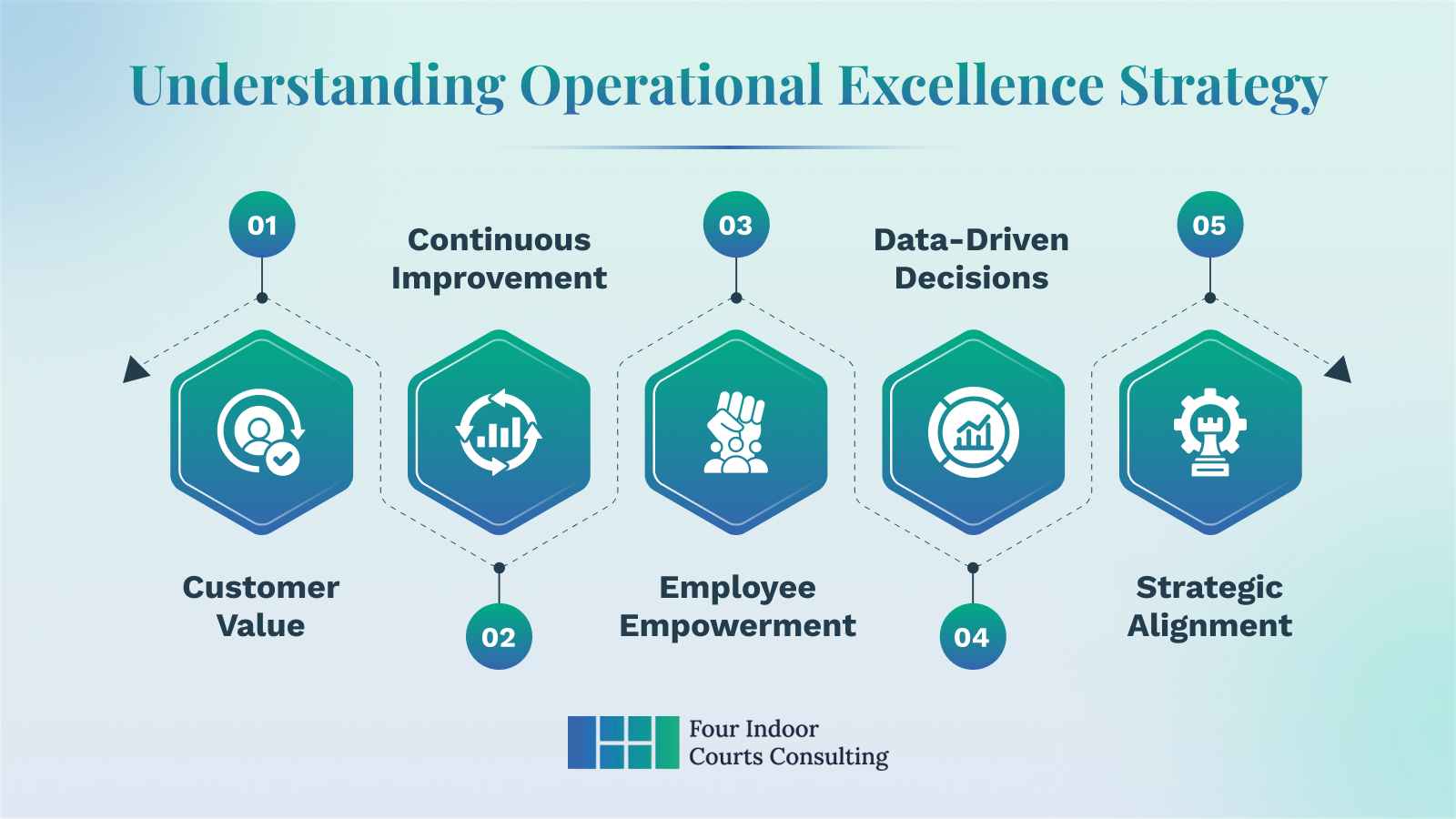
A strong operational excellence strategy focuses on:
- Customer value: every action should improve the customer experience.
- Continuous improvement: progress is never finished.
- Employee empowerment: people closest to the work drive innovation.
- Data-driven decisions: measure what matters.
- Strategic alignment: improvement efforts support your vision and growth targets.
Core Principles and Benefits of Operational Excellence
1. Customer Focus
Operational excellence starts where the customer experience begins. Whether it’s an online order, a paid marketing strategy, or a client update, consistency builds trust.
Higher customer satisfaction is a key building block. Do you monitor yours and engage with your audiences? Track all the comments, feedback and reviews across social media - they’re real-time operational data and often a reflection of your business pain points. If you can see where satisfaction drops, you can fix it fast.
2. Leadership Commitment
Improvement only sticks when leadership models it. Small-business leaders set the tone by being transparent about priorities, sharing performance metrics, and celebrating progress. They understand that business management isn't done in a silo (or in their head!) and business performance relies on everyone feeling invested. Take the big business concept of 'employee satisfaction' and apply it to the people who work around you - are they happy, are they motivated, are they 'on your side'. If not, start listening to them, talking to them and sharing with them.
If leaders treat improvement as optional, the team will too.
3. Culture of Continuous Improvement
Good big business empower employees to flag inefficiencies and test new ideas. They involve them in change management and rely on them to improve process efficiency. That's because the best process improvements often come from the people who use them daily. Encourage and reward experimentation not perfection - and that includes your own! Be open to market changes and how you flex to reflect them.
4. Data-Driven Decision-Making
Data doesn’t need to mean dashboards and data scientists. But an element of data analysis plays a crucial role in even the smallest business. For modest or sole teams, it might be tracking weekly lead times, error rates, insights from Instagram analytics or Google Reviews. Every bit of data insight is your 'voice of the customer.'
5. Alignment with Business Objectives
Every process upgrade should directly support your larger goals - growth, margin improvement, or customer retention. Otherwise, you risk optimizing the wrong things.
The Value of Achieving Operational Excellence

When operational excellence becomes part of daily work, the payoff is measurable.
- Efficiency and Cost Savings: Streamlined workflows free up cash flow and time.
- Customer Loyalty: Consistency creates repeat business and word-of-mouth referrals.
- Employee Engagement: Teams feel ownership when they can fix problems and see results.
- Sustainable Growth: Quality and reliability attract investors and partnerships.
- Competitive Edge: Small companies that run smoothly outpace larger, slower rivals.
Key Takeaway: Operational excellence is how small businesses scale without losing control.
Key Components of an Operational Excellence Program
Process Optimization and Waste Elimination
Examine every step of your service or production cycle. Waste comes in all shapes and sizes - it's not reserved for manufacturing processes! Identify wasted time - extra approvals, double entry, idle waiting, unclear communication - and remove or automate it. Lean management can help with cost reduction, waste reduction and give you a better flow of value.
Employee Empowerment and Training
Give team members tools to solve problems, not just instructions to follow. A one-hour improvement meeting each month can uncover major savings and if people need or want to go on training programs, look for high-quality online courses, podcasts and workshops that are low to no cost. This kind of proactive improvement can kick-start employee productivity, quality standards and motivation.
Strategic Objectives and Leadership Accountability
Set two or three operational priorities at a time. Track them publicly, on a wall board or shared dashboard, so everyone sees progress. Or just gather the team together for lunch and talk about it! This kind of transparency and informality takes the benefits of big organizational culture and high-performance, but adapted for the reality of a founder-led operation.
Modern Operational Excellence Examples and Tools
Borrowing Big-Company Systems, for SMBs
One of the most popular improvement methodologies used at enterprise-level is Lean Six Sigma. It can be expensive, complex and time consuming and certainly not something that SMBs necessarily need. However the principles and processes are fascinating. Here's a couple of ways the core elements can be adapted to help the organizational performance of any business
Lean Thinking: this focuses on removing waste and making workflows smoother. ‘Visual Management’ is a great tool.
- Try the 5S method (Sort, Set in order, Shine, Standardize, Sustain) to tidy up physical and digital spaces.
- Use Kanban boards in Trello or Asana to visualize work and reduce overload.
- Run a Value Stream Map for any service - from order to delivery - to find where delays occur.
Six Sigma Discipline: Centers on solving recurring issues with data.
- Apply DMAIC (Define, Measure, Analyze, Improve, Control) to fix chronic bottlenecks.
- Use Pareto Charts to pinpoint the few causes driving most problems.
- Use Fishbone Diagrams for root-cause analysis during team huddles.
These tools work best when simplified and made visible to you and the people around you. You don’t need a full program of new business processes to add to your workload, just a desire to look at problem-solving and a commitment to consistent habits.
Leveraging Technology and AI for Operational Efficiency

Achieving Operational excellence must include some digital fluency. Automation and AI allow even the smallest company to operate with enterprise-level precision. It’s built into most online tools and there are neat plug-ins for business operations that are invaluable for small teams. You might not need a complete digital transformation, but being open to new technology is one of the core principles of operational excellence.
Process Automation
Link systems with tools like Zapier or HubSpot to remove repetitive admin work, including invoicing, reminders, data transfers, email campaigns and customer feedback.
Example: A design agency connected its CRM to email and billing platforms. Each new client triggered a welcome message, task creation, and invoice draft automatically. Result: 10 hours saved weekly.
AI as a Process Partner
Artificial intelligence is you secret weapon for incremental improvements. Think of it as a team of the world's best experts on hand to give you intelligent advice on everything from your business strategy to analyzing customer feedback. It's also a great way to pick up some of the load and rapidly assimilate data or create documents.
- Use AI chatbots to handle routine customer service.
- Employ AI analytics to forecast demand or flag underperforming products.
- Generate first-draft reports or SOPs using text-generation tools to cut prep time.
AI doesn’t replace people; it removes the friction that slows them down.
The Digital Edge: Social Media and Continuous Feedback
Operational excellence is built on feedback, and social media is now one of the richest sources of your customer expectations and experience.
Treat your digital channels as living performance dashboards of your customer needs and customer demands:
- Monitor sentiment and recurring comments to identify service issues.
- Use polls and stories to test new ideas before launching them widely.
- Track engagement as a leading indicator of customer satisfaction.
Example: A small fitness studio noticed Instagram engagement dropping during mid-day posts but peaking at lunchtime and evenings. Adjusting their schedule boosted sign-ups 35% with no added ad spend.
Automation also plays a role in marketing operations: create and schedule posts, auto-reply to FAQs, or trigger thank-you messages after purchases. These actions improve consistency and free up humans for other work.
Steps to Implement Sustainable Improvement Initiatives
- Set a Clear Vision and Operational Goals
Define what excellence looks like for your business in 12–24 months - Identify Root Causes and Opportunities
Map your processes and ask “why” five times until you reach the source of the issue. - Focus on Cycle Time Reduction
Pick one process to improve at a time. Success breeds momentum. - Engage Your Team
Create ownership with simple visual boards and weekly check-ins. - Track Key Metrics
Measure performance and share results. Transparency drives accountability. - Adapt Continuously
When customer behavior shifts (visible in sales or social metrics) adjust your process quickly.
Improvement doesn’t need to be complex; it needs to be continuous.
Best Practices for Small-Business Excellence
- Standardize workflows but leave room for innovation.
- Use digital tools to visualize performance daily.
- Empower every employee to identify improvements.
- Build automation into repetitive admin.
- Turn customer and social feedback into operational gold.
- Set key performance indicators
- Recognize and reward small wins; they compound fast.
Driving Business Transformation

Operational excellence isn’t a one-time project; it’s a business habit. The companies that thrive are those that make improvement routine and measurable and stick to the good habits,
It can be very satisfying when the energy shifts and people inside and outside of your business start to notice a change. It's even better when the business performance improves and you can see yourself getting closer to your goals and aligning with your vision.
When systems work and communication flows, you get more time to focus on growth instead of being dragged down by the day-to-day.
Key Insight: Excellence is company culture — not compliance.
How Operational Excellence Supports Long-Term Success
- Consistency builds trust: predictable delivery and quality drive repeat business.
- Data improves agility: AI and analytics reveal patterns before problems emerge.
- Employees stay engaged: they see results and feel valued.
- Customers stay loyal: they get what they expect, every time.
- The business becomes investable: strong systems attract partners and funding.
Operational excellence, powered by modern tools, is how small businesses punch above their weight — delivering with the confidence and control once reserved for corporations.
Final Takeaways
- Operational excellence belongs in every small business.
- Borrow the principles, shrink the process, and make it digital.
- AI, automation, and social media aren’t distractions - they’re modern accelerators of efficiency and insight.
- Continuous improvement isn’t a department; it’s a mindset.
- The goal isn’t perfection - it’s progress, measured, visible, and sustainable.