

A founder generating $1.2M in revenue works 70-hour weeks and still can’t take a Friday off without the business stalling. That’s not an ambition problem. It’s an operations problem. It’s exactly the moment small business owners bring in a business consultant who earns their fee. This article walks through what these consultants do, the real cost ranges, the signs you’re ready, how to pick one, and where a fractional COO fits when a generic advisor isn’t enough.

What a small business consultant does and when you need one
A small business consultant is hired to find what’s broken and fix it. That covers three broad areas: operations, finances, and marketing. In practice, business consulting and advisory maps how work flows through your company. They spot the operational bottlenecks slowing everything down, run financial analysis to see where margin leaks, and build growth strategies you can execute without guessing.
Here’s the distinction that trips people up. Small business consulting is problem-focused and time-bound, while coaching develops you as a leader. If your cash conversion cycle is a mess, you need a consultant. If you freeze under pressure and can’t delegate, that’s coaching territory. Understanding the difference between business and management consulting helps here too, since many founders assume they need one when they actually need the other.
A solid engagement runs as a cycle: diagnose, design the fix, then help your team execute it. The last part matters, because a report that sits in a drawer changes nothing; change only sticks when someone drives the implementation. The U.S. Small Business Administration keeps practical guidance on when outside advisory help pays off, including its free counseling and mentoring resources for owners weighing that decision. Its broader U.S. Small Business Administration guidance on managing your business covers the operational fundamentals a consultant will inevitably examine.
You need a business consultant for small businesses when a problem is real, costing money, and outside your team’s skill set. A retailer watching same-store sales slide for three straight quarters doesn’t need a pep talk. It needs someone to run the numbers and rebuild the plan.
Signs your business is ready for a consultant (founder overwhelm, bottlenecks)
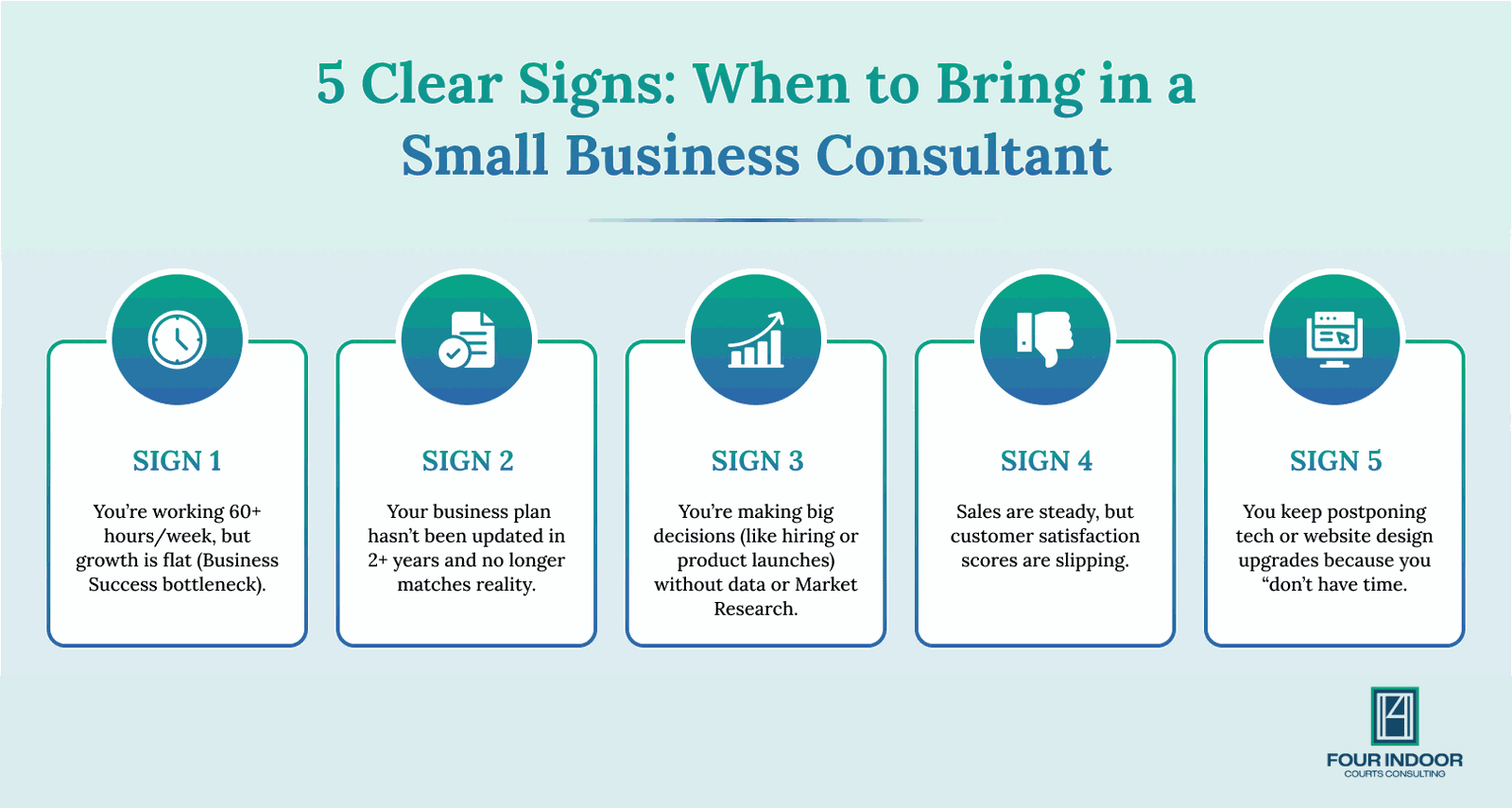
Here’s the honest signal most founders miss. The business runs fine, but only because you’re the glue holding it together. That’s founder overwhelm, and it’s a ceiling, not a badge. When every decision routes through you, business growth stops the moment your attention runs out, because the business can only move as fast as one person can process it.
Watch for these patterns. Revenue climbs, but profit doesn’t. Your team asks you the same questions weekly because processes live in your head, not a system. You’ve stopped strategic planning because you’re buried in daily firefighting. You can’t see your numbers, so you rely on gut instead of data. Learning delegation strategies when you’re drowning in day-to-day work is often the first meaningful step out of this trap.
The root cause is almost always visibility. The issue usually isn’t effort. You can’t see where the operational bottlenecks sit, so you can’t fix them. Scaling exposes weaknesses a smaller business could absorb by working harder. At $1M+ in revenue, working harder stops scaling. This is also where growing a small business past $1M becomes a systems question, not an effort question.
Picture a team that hits $1.5M in revenue with the same manual processes they used at $300K. Order errors climb, and hiring slows because nobody’s been trained on documented systems. A founder who should be setting business strategy is instead approving purchase orders at 9 p.m., and the cost shows up as lost capacity and burned-out staff. Harvard Business Review has documented how founder-dependency stalls growth as companies scale. When two or three signs sound familiar, small business owners are past ready to hire a consultant.

Concrete benefits and outcomes of hiring a consultant
Skip the vague promises. The value of small business consulting services shows up in specific, measurable places.
First, operational visibility. A good consultant installs KPI tracking so you can actually see performance instead of guessing. Once you can measure lead time, gross margin per service line, and utilization, you make better business decisions in minutes instead of debating for weeks.
Second, process improvement that frees your calendar. Documented business systems mean work no longer depends on you remembering how it’s done. Delegation becomes real, not theoretical. That’s how founders climb out of the day-to-day. It’s worth seeing how one $1M agency turned its operations around to understand what that shift looks like in practice.
Third, focused business growth. Instead of chasing five directions at once, you get growth strategies ranked by return, tied to a business plan your team can follow. Insight from someone who has watched dozens of companies scale means you skip the expensive mistakes.
Results vary based on leadership execution, market conditions, and how fully you implement the changes. No honest consultant guarantees a revenue number. What they reliably work toward is clearer business management, tighter operations, and a structure that supports steadier growth instead of buckling under it.
The outcome that matters most is often the least glamorous. An owner who can step away for two weeks and return to a business that ran fine without them. That’s the difference between owning a job and owning a company.
How to choose the right consultant for your small business
Then screen hard on three things. First, industry track record. Have they solved this specific problem for businesses at your revenue stage? A consultant who scaled a services agency understands different bottlenecks than one who fixed a manufacturing line. Ask for concrete outcomes, not a list of logos.
Second, result metrics. How do they define success, and how will you both measure it? If a consultant can’t tell you what number should move and by when, they’re selling activity, not outcomes. Get it in writing before you sign.
Third, the working model. Understanding the consulting service models and how each engages matters. A freelance consultant offers focused expertise at lower cost but limited bandwidth. A consulting firm brings depth but often layers junior staff between you and the senior brain you’re paying for. Decide which fits your problem, and whether an upfront free consultation with each helps you compare.
Many assume the priciest consultant delivers the most value. In reality, fit and focus beat brand name, because a specialist already knows the failure patterns at your stage and skips the learning curve you’d otherwise pay for. A specialist who has fixed your exact scaling challenges twice will usually outperform a big-name generalist. Check references, and ask each one what didn’t go well, not just what did.

ROI: Is a business consultant worth the cost?
Let’s talk money honestly. The pricing splits into recognizable models. Hourly consulting runs $100 to $400 an hour, useful for a defined, short question. Project-based consulting lands between $5,000 and $50,000+ depending on scope, best when you have a clear deliverable. Retainer-based consulting typically runs $2,500 to $7,500 monthly. Some senior operators use value-based pricing tied to results.
The return-on-investment math is simpler than it looks. Say a consultant charges $30,000 to redesign your fulfillment process. If that redesign cuts $8,000 a month in wasted labor and errors, you break even before month four and gain every month after. That’s the frame: cost of the engagement versus the cost of the problem staying broken.
The trap founders fall into is comparing consultant fees to zero instead of to the real cost of the status quo. Every month a broken process runs, it charges you a fee too, in lost margin, burned staff, and missed capacity. You just never see the invoice.
Here’s the honest caveat. Return on investment depends heavily on execution. A brilliant plan you don’t implement returns nothing. Value shows up when the fixes stick, which is why the strongest engagements include implementation support, not just advice. Cheap advice that changes nothing is the most expensive option.
Fractional COO as a senior alternative to a generic consultant
Here’s what a generic consultant often can’t do: stay and run the thing. A fractional COO is senior operational leadership on a part-time basis. This person owns execution rather than handing you a strategy and walking away. For founder-led businesses past $1M in revenue, that gap is usually the whole problem.
A traditional consultant diagnoses and recommends. A fractional COO diagnoses, recommends, then actually builds the business systems, drives the process improvement, and holds the team accountable to the plan. You get senior operational depth without the $250K+ salary and equity of a full-time hire. This is where Four Indoor Courts fits: fractional COO services for small businesses that install KPI tracking, delegation frameworks, and scalable operations so the business stops depending on the founder for every decision.
The misconception worth killing: many founders think they’re too small for operational leadership, or that their managers already handle operations. In reality, having managers who execute daily tasks isn’t the same as having a leader who designs the structure those managers work within. That structural gap is exactly what stalls steady growth.
Engagement models flex to the problem. Some businesses need business consulting and advisory for day-to-day overwhelm. Others need full vision-to-execution integration to align a fast-growing team. The point isn’t more advice. It’s an experienced operator turning operational chaos into a structure that scales responsibly.

How to get started: readiness audit and clarity call path
You don’t need a signed contract to find out whether outside help is worth it. If you’re wondering how to get started, the smart first step costs nothing.
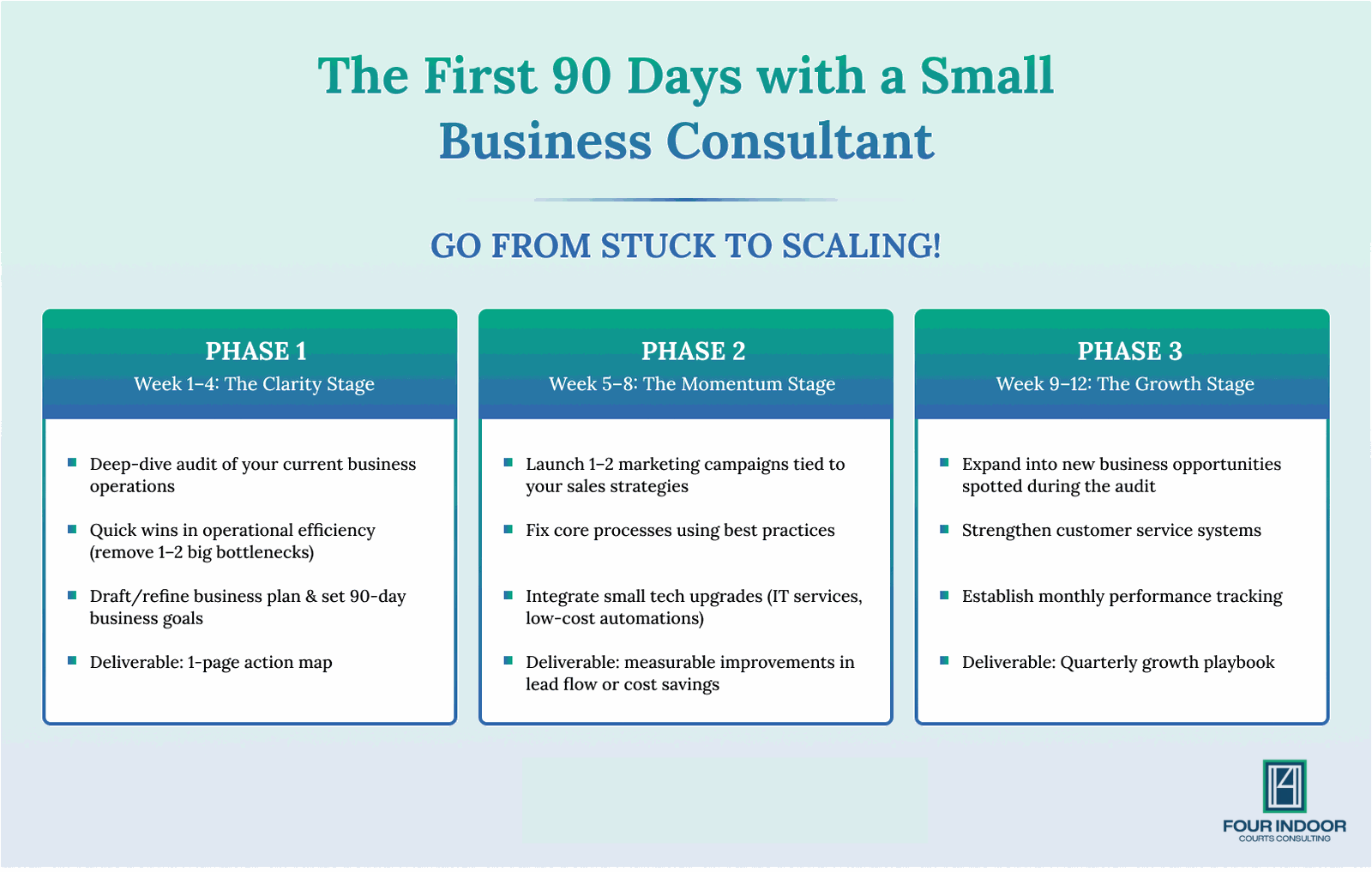
Start with a readiness audit. This is an honest look at where operational friction is actually slowing you down, before anyone proposes a solution. It answers a plain question. Is your business at the point where senior operational support pays for itself, or should you fix one or two things yourself first? Naming the real problem is half the work.
From there, the path is straightforward. A free consultation maps your specific bottlenecks and priorities. That feeds strategic planning and business strategy so you know what to fix first and what it should return, guiding better business decisions. Then ongoing support keeps the changes sticking as you scale.
If you’re weighing whether to hire a consultant or a fractional COO, this sequence answers it without pressure. You can book a free 30-minute Readiness Audit to surface whether your gap is a one-time project or ongoing operational leadership, offering useful insight before you commit. Most founders learn more in a 30-minute call than in weeks of debate, because an outside operator spots the problem areas you’ve normalized.
Why Leah Norris is the right business consultant for your business
When you hire a consultant, you’re not buying a generic service; you’re choosing a partner who can guide your business through decisions that affect cash, customers, and your bottom line. Leah Norris brings two rare advantages to the table:
- Years of experience actually running a business (not just advising from the sidelines).
- The ability to turn data analysis into day-to-day actions that small teams can actually execute.
Years of Experience and Proven Consulting Expertise
Before founding Four Indoor Courts Consulting, Leah bootstrapped a multi-stream tennis facility from the ground up. That meant handling business operations, staffing, marketing, financial management, and yes, fixing leaky ceilings between matches.
She then spent over a decade in analytics, learning how to make numbers talk, whether that’s spotting a hidden profit leak or predicting which marketing channel will deliver the next 50 paying customers.
Specializing in:
- Business solutions that fit the realities of small business owners in the United States.
- Performance management that motivates without micromanaging.
- Helping clients in various industries, from e-commerce to real estate, service-based companies to Financial Services, find their growth lanes.
Let’s make your next 12 months your best yet.
Whether it’s sharpening your business plan, streamlining business operations, or finding untapped new business opportunities, the first step is simple:
Schedule your free consultation here and get expert, actionable guidance specific to your business.
Client Reviews and Real-World Results
Leah’s approach has earned consistent praise from potential clients who become repeat partners. Why? Because she delivers outcomes you can measure:
Case file 1 – Marketing Analytics Upgrade
- Before: Lead acquisition was a black box- lots of money was going out but no one was really sure whether the spend was effective or not.
- After: Within four weeks, Leah implemented a lead tracking system with a live connection to the CRM to track incoming leads by channel in real time, and layer in the amount of spend to evaluate performance. This led to better allocation of funds, resulting in 2x the number of weekly leads without increasing the marketing budget.
Case file 2 – Service Business Expansion
- Before: A business owner was creating a bottleneck and preventing his own growth by being too involved in service delivery.
- After: Leah created a full org chart and recruited, hired, onboarded, and trained the new team members that were sorely needed to support the business’ expansion. Revenue tripled within 4 months.
If your business is growing faster than your systems can support, a clarity call with Four Indoor Courts can pinpoint where operational friction is costing you time and margin, starting with a free 30-minute Readiness Audit with Leah Norris. Get your free readiness audit and leave with a clear picture of your next step, whether or not you engage further.
FAQs
Q1. What does a business consultant for small businesses actually do?
A1.
They assess your operations, identify bottlenecks, and build actionable strategies across areas like finance, marketing, or process design. Many go further and help implement the changes or guide your team through execution, not just hand over a report.
Q2. How much do small business consultants charge?
A2.
Hourly rates typically run $100 to $400, with specialized work like AI consulting landing on the higher end. Project fees range from $5,000 to $50,000+, and ongoing monthly retainers usually fall between $2,500 and $7,500 depending on scope.
Q3. When should a small business bring in a consultant?
A3.
The clearest triggers are plateaued growth, declining sales, and internal processes that have become too cumbersome to fix from the inside. For founder-led businesses near $1M+ revenue, that moment usually arrives when growth breaks the systems that got you there.
Q4. What if a consultant's advice doesn't fit my industry?
A4.
That risk drops when you screen for a relevant, sector-specific track record before hiring; experience in your industry’s nuances leads to more usable solutions. Ask for concrete outcomes with businesses at your revenue stage, not generic credentials alone.
Q5. How do I choose the right consultant for my small business?
A5.
Define the exact problem first (cash flow, marketing, or operational visibility), then match it to a consultant with a proven record solving that specific issue. Verify credentials and ask how they measure results before committing to a retainer.

Founder of Four Indoor Courts Consulting, Leah Norris helps founders and growing businesses create operational clarity through fractional COO leadership, KPI-driven analytics, and scalable operational strategy. With a background spanning operations, finance, analytics, marketing, and technology, Leah specializes in helping businesses improve visibility, streamline processes, strengthen accountability, and build the operational structure needed for sustainable growth.