A cautionary ‘tale’ of a $1M dog-day-care founder’s near-exit, and the operational turnaround that changed everything


Key Takeaways
- Burnout destroys value: nearly half of U.S. small-business owners report burnout, and up to 80% of founder-led businesses listed for sale never sell, often because they rely too heavily on the owner.
- Founder dependency is the silent killer of premium service firms: when every decision and delivery route depends on the founder, growth amplifies stress instead of stability.
- Operational redesign is the unlock: strategic restructuring, hybrid staffing (on-site + offshore), and hands-on mentoring can free founders from daily troubleshooting without inflating payroll.
- Replaceability drives resilience and valuation: buyers, and founders, value businesses that run on systems, not personalities.
Freedom is the real payoff: this case study shows how one high-end dog-day-care business moved from burnout to balance—growing revenue, cutting turnover, and reigniting the owner’s passion to lead again.
1. The Founder Crossroads: When Success Turns Into Strain
In the U.S., founder-led service businesses are powerful engines of the economy – and frequent casualties of burnout. According to the U.S. Chamber of Commerce, 42% of small-business owners report recent burnout, while research from Exit Strategies Group shows that 70–80% of small businesses listed for sale never actually sell. The reason isn’t lack of demand. It’s operational fragility: businesses built around the owner rather than systems.
That inflection point hits quietly. Revenue looks strong, clients are loyal, but the founder’s time is gone, their energy tapped, and decisions bottlenecked at the top. The moment they start whispering, ‘Maybe I should just sell,’ it’s usually not about profit, it’s about exhaustion.
This case study follows a premium dog-day-care business offering high-end training, collection, and delivery services. It’s also a story for any founder-led premium service firm – marketing agencies, wellness studios, design consultancies – facing the same risk: building something exceptional that becomes impossible to sustain.
FICC was brought in when the founder, a highly skilled animal behaviorist, was on the verge of walking away from a company she loved. Staff turnover was high, margins were tight, and she couldn’t find affordable senior operations help. The challenge was clear: free the founder, stabilize the business, and reignite both growth and passion.
2. Market Context: Opportunity Meets Operational Pressure
The U.S. pet-care market tells a story of huge demand and hidden strain. Americans spent $147 billion on pets in 2023, with services like grooming, boarding, and day care up 20% year-on-year (American Pet Products Association). Premium dog-care alone is projected to grow from $2.6 billion in 2024 to $4 billion by 2030, driven by ‘pet humanization’ and dual-income households.
That growth masks a systemic issue: service businesses that scale faster than their operations can handle. The same pattern appears across industries - fitness, hospitality, home services, even digital agencies - where founders remain central to delivery, decision-making, and quality control.
The result? Staff churn, customer inconsistency, and rising personal fatigue. Many owners respond by selling under pressure rather than fixing the core. A 2024 Business.com survey found one in four small-business sales are triggered by burnout, not strategy. It’s an expensive exit; burnt-out founders typically accept 30–40% below market value, according to the U.S. Small Business Administration.
3. The Breaking Point: Inside the Founder-Dependency Trap
In this business, all roads led back to one person.
The founder was the brand, the expert every client wanted. That intimacy built loyalty but also dependence. As the client base grew, so did the moving parts: seven drivers, multiple service zones, training programs, scheduling, billing, and client communication.
Margins tightened, but the owner resisted hiring senior help. Local operational talent was expensive and rarely multi-skilled. The result was unsustainable: drivers leaving monthly, administrative errors compounding, and daily problem-solving. It wasn’t fun for anyone.
This is the anatomy of founder dependency. When every major decision, crisis, and approval rests with the owner, growth amplifies stress instead of creating stability. The more successful the business, the more fragile it becomes.
By the time FICC entered, the owner was thinking about selling, not because she wanted to leave, but because she couldn’t see another way to cope.
4. The Intervention: What FICC Did, How It Worked, and Why
FICC’s consulting model focuses on operational replaceability, the process of designing a business that runs without its founder at the center. In this case, the roadmap looked like this:
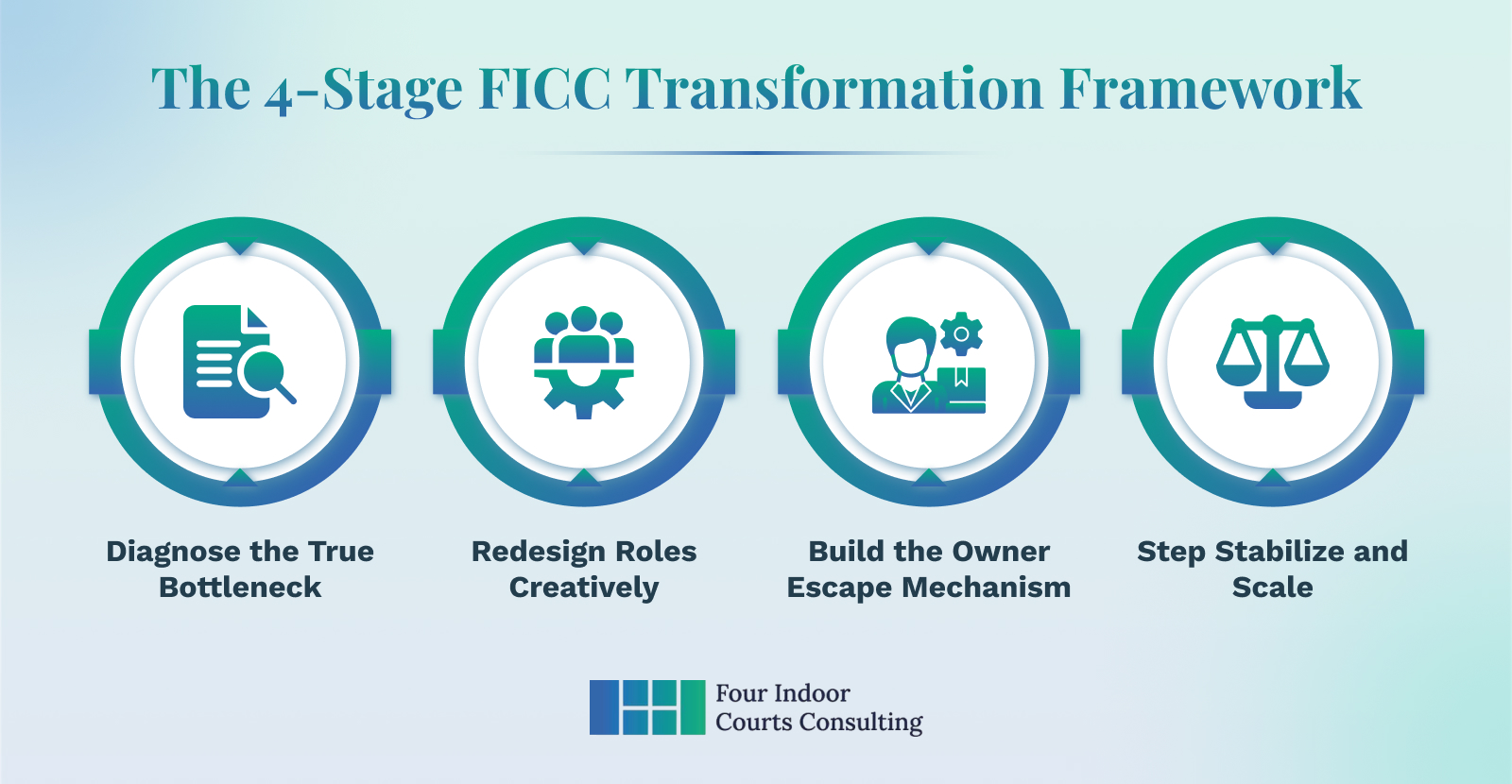
Step 1: Diagnose the True Bottleneck
We mapped the existing organization (roles, stress points, decision chokeholds) and created an ‘ideal-state’ org chart. It visualized where accountability should sit, which tasks could be delegated, and what roles were missing.
Step 2: Redesign Roles Creatively
Instead of one costly full-time local operations manager, we proposed a hybrid model: one on-site operations manager plus one remote/offshore counterpart. This 50/50 split freed budget to hire a ranch-hand who could double as an emergency driver, closing a critical gap.
Step 3: Create the Owner Escape Mechanism
We established a live Slack channel linking the founder, operation team, and FICC advisor. This allowed real-time mentoring and neutral problem-solving, defusing daily pressure while giving FICC direct visibility into operational pain points.
Step Stabilize and Scale
With structure, oversight, and cross-training in place, staff turnover plummeted. Processes became repeatable, decision-making distributed, and the owner regained mental space to think strategically rather than reactively.
Why it worked: it replaced emotional, founder-centric control with documented systems, empowered staff, and a blended team model that delivered both expertise and affordability.
5. The Results: Quantifiable Change
- Turnover: From losing a driver every month to losing maybe one or two per year.
- Revenue: Grew from under $1 million to over $1.3 million annually.
- Owner Freedom: The founder moved from daily operations to oversight, focusing on growth and client experience.
- Resilience: With dual operations managers and a trained support tier, the business could now function independently; continuity without chaos.
Perhaps the most meaningful result: the founder no longer wanted to sell. She rediscovered the energy and vision that launched the business in the first place.
6. Lessons for Every Founder-Led Business
This isn’t a pet-care story, it’s a mirror for any premium service firm where the founder is the bottleneck. The same operational dynamics apply to digital agencies, boutique fitness brands, private education providers, and consultancies.
Three lessons stand out:
- If your business can’t run without you, it’s not scalable and it’s not sellable. Buyers value systems, not personalities.
- Creative resource design beats burnout math. Hybrid on-shore/off-shore structures can unlock high-quality talent without blowing the payroll.
- Operational visibility reduces emotional volatility. Founders under pressure make reactive decisions. External oversight creates calm, clarity, and control.
FICC’s framework turns those lessons into practical architecture: defining where stress originates, re-engineering how the business operates, and mentoring leaders through the transition.
7. The Payoff: Falling Back in Love With the Business
The goal wasn’t exit. It was freedom.
The founder moved from ‘I can’t do this anymore’ to ‘I can choose what’s next.’ With a functioning team, replaceable systems, and space to lead, she stopped firefighting and started innovating again.
This is the real promise for founder-led enterprises: the ability to scale sustainably, protect valuation, and rediscover the satisfaction that made you start in the first place.
For many small-business owners, that’s the ultimate success metric: not selling, but having the option to stay because you want to, not because you have to.
If your business is showing the same signs; daily troubleshooting, high staff turnover, stalled growth– FICC helps founders regain control, design scalable operations, and build teams that let them lead again.